

I spent this weekend thinking about where I want to take risk from here (we were supposed to be enjoying the mountains; my girlfriend was getting a little tired of hearing about the market). I keep coming back to the same names, which is a bit frustrating when you enjoy finding companies nobody talks about.

But first, a quick catch-up.
The Saudi pipeline attack is another escalation, and how long the disruption lasts matters. I wouldn’t dismiss it. Still, I don’t want every article to become the same conversation about Iran and oil. My view hasn’t changed much: I’m bullish over the medium term, but uncomfortable with the risks.
I feel similarly about rates. One or two hikes don’t necessarily kill the bull market. Inflation becoming persistent enough to force a long hiking cycle would worry me much more. I’m watching that, but I don’t want to invest as if the worst outcome is already certain.
This weekend also brought Dario’s call to slow frontier AI development, with support from Sam and Elon. That could put pressure on semis in the short term. We’ll see how markets react.
The market is an evolving beast, and I get the feeling its appetite is starting to change.
What interests me right now?
Hyperscalers. Not particularly exciting, I know.
Amazon, Google, Microsoft and Meta.
I feel like we’ve become comfortable buying the companies selling AI infrastructure while worrying about the companies paying for it. That makes sense up to a point. The suppliers get their revenues now; their customers have to prove the return later.
But I’m starting to wonder whether the next opportunity is on the other side of that trade.
Last week I saw a thesis on X that stayed with me. What if the rush to build data centers was partly a rush to get connected to the grid before those connections became much harder to obtain?
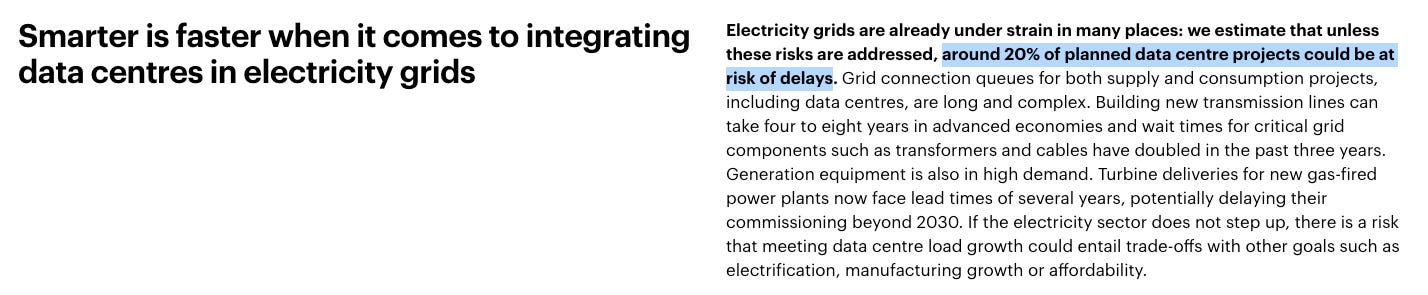
The power bottleneck is real. The International Energy Agency (IEA) estimates that grid constraints could delay around 20% of planned data-center capacity by 2030 unless they are addressed. IEA
What if hyperscalers saw this coming and decided to build as much as they could, as quickly as they could?
I don’t know whether that explains their decisions. But it makes sense to me. A working connection becomes much more valuable when the next company has to wait years for one.
This is where the investment idea gets interesting.
If new capacity becomes harder to add, spending growth could eventually slow. Meanwhile, the infrastructure already built could keep generating more revenue as customers use it. That would give cash flow a chance to catch up.
What I’m looking for is evidence that the money already spent is starting to earn its return.
At the end of the day, that is what we ask businesses to do: reinvest their profits well. Yet sometimes I feel we are treating AI spending with the same suspicion we had towards Meta’s metaverse spending in 2022.
I understood the skepticism then. But compute feels different to me. There are already customers paying for it and companies using it to improve businesses that make money today. That doesn’t justify any amount of capex, but it gives us something concrete to judge.
Amazon, Google and Microsoft interest me because they can sell that compute to customers they already serve. Meta interests me more as a direct application of AI: better recommendations, better advertising results and potentially better efficiency.
If Meta can keep turning AI improvements into profits, that would be an encouraging sign for the broader investment cycle. Not proof that every project works, but something more useful than another impressive demo.
Amazon and Google also have Trainium and TPUs. I wouldn’t assume those chips are more efficient than Nvidia’s for every task. But being able to design hardware around your own workloads could become more valuable when power is scarce. Getting more useful work from the same electricity is another way to grow.
I’m not saying these stocks are automatically cheap, or that semis need to fall. For the index, the better outcome would be semis holding up while hyperscalers start getting more credit for the returns on their spending.
That is one way I can see the S&P 500 moving towards 8,000.
I still struggle to find the overlooked opportunities I used to find in smaller companies. Maybe that is making me more cautious. But I also don’t want to ignore an opportunity just because everyone already knows the ticker.
For now, these are the names I want to spend more time on. Not the most exciting conclusion after a weekend thinking about markets, but it is the honest one.
All the best,
Arctic
P.S. If you enjoyed this one, a like or restack would mean a lot. Thanks for helping me get the letter going again.