

Sometimes the market is described as an all-knowing force. It anticipates events, prices in the future and sees things before the rest of us. Often, that is true. But sometimes the market is just as uncertain as we are about what comes next.
Right now, I feel we are in one of those moments.

AI is advancing rapidly, and its use cases keep multiplying. This should be good for productivity and, over time, for the economy. But for investors, it also raises some difficult questions.
For the last two years, we’ve seen an incredible run in the companies receiving AI capex. This made sense: infrastructure spending was the most visible part of the story. Whatever happened with the models, someone had to supply the chips, networking and power.
After that rally, I find the asymmetry less compelling. Expectations are higher, and the market is trying to anticipate the next winners.
What’s the problem?
I don’t think the market has a clear answer yet. Some days, it favours software companies that could benefit from AI adoption. Other days, it returns to the cloud companies providing the compute. There is conviction about the technology, but much less agreement about who will capture its value.
Muse has added another layer to this debate. What I find encouraging is that people seem to be doing more than talking about it. They are trying it and finding ways to use it.
Whether that lasts beyond the initial excitement is another question. Trying a product is one thing; making it part of your daily routine is another. Still, the interest gives us a glimpse of what broader adoption of AI agents could look like.
And with that comes a new set of questions.
We’ve spent months talking about agentic AI in fairly abstract terms. Once people start using something that can act on their behalf, the implications become easier to imagine. Who benefits? Who loses the customer relationship? Who still gets paid?
Travel aggregators such as Booking and Trivago have become part of this debate. If an agent can research a trip, compare prices and arrange a booking, how much value stays with the websites we use today? Booking and Trivago have very different businesses, but both face questions about their role in that journey.
The argument could extend much further, including to parts of Amazon’s retail and advertising business.
Digital advertising has helped fund the internet for decades. Humans browse, compare products, click links and see ads along the way. An agent carrying out a task may skip much of that journey. It gets the information it needs, completes the task and leaves.
That could change the economics of a large part of the internet.
It doesn’t mean advertising disappears. Ads could move into AI interfaces through sponsored recommendations or paid placement. But that still leaves a big question: who captures the spending? The platform that owns the agent, the website supplying the product, or an intermediary connecting them?
There is an interesting tension here for Meta. Excitement around Muse could strengthen its AI narrative while also raising questions about the advertising model that funds the company.
I wouldn’t take that argument too far. People delegating their shopping or travel research may still spend hours watching videos and following creators. The risk is more direct for businesses built around comparison and referral traffic. But it shows how the same technology can create opportunities and uncertainty within a single company.
Until recently, the main market narrative was the productivity AI could unlock. What if the next phase is increasingly about uncertainty over existing business models?
The interesting thing is that these businesses don’t need to disappear for their stocks to struggle. Confidence in future earnings matters. If investors become less certain about what an internet business will earn in five years, they may simply pay a lower multiple for it. Earnings could keep growing while the stock goes nowhere.
So where could the money go?
In the short term, markets are heavily influenced by flows and rotation. My view is that some capital could move towards businesses where investors have greater confidence that demand will survive agentic AI.
Hospitals, rehabilitation facilities, water infrastructure and waste collection are good examples. I don’t need to know which AI model wins to believe that people will still need surgery, drinking water and rubbish removed.
These businesses could also benefit from AI through less paperwork, better scheduling and more efficient operations. The attraction is the possibility of capturing some productivity gains while keeping their core demand intact.
Of course, resilience has a price. A hospital or a water utility can still be a poor investment if you pay too much for it. Physical assets also come with debt, maintenance costs and regulatory risk. Being difficult for an agent to replace is only one part of the investment case.
AI biotech is another area I’m watching, although for a different reason. There, the opportunity is whether AI can improve the speed and economics of drug discovery. That is a more speculative productivity thesis, and I would separate it from the defensive argument above.
For now, I’m interested in businesses whose valuations leave room for a reasonable return without aggressive growth assumptions, and where AI is more likely to change how the work gets done than remove the need for it.
I don’t need to identify every loser to look for opportunities on the other side of that uncertainty.
Here’s a broad list of companies that could benefit from a rotation towards businesses less exposed to AI disruption:
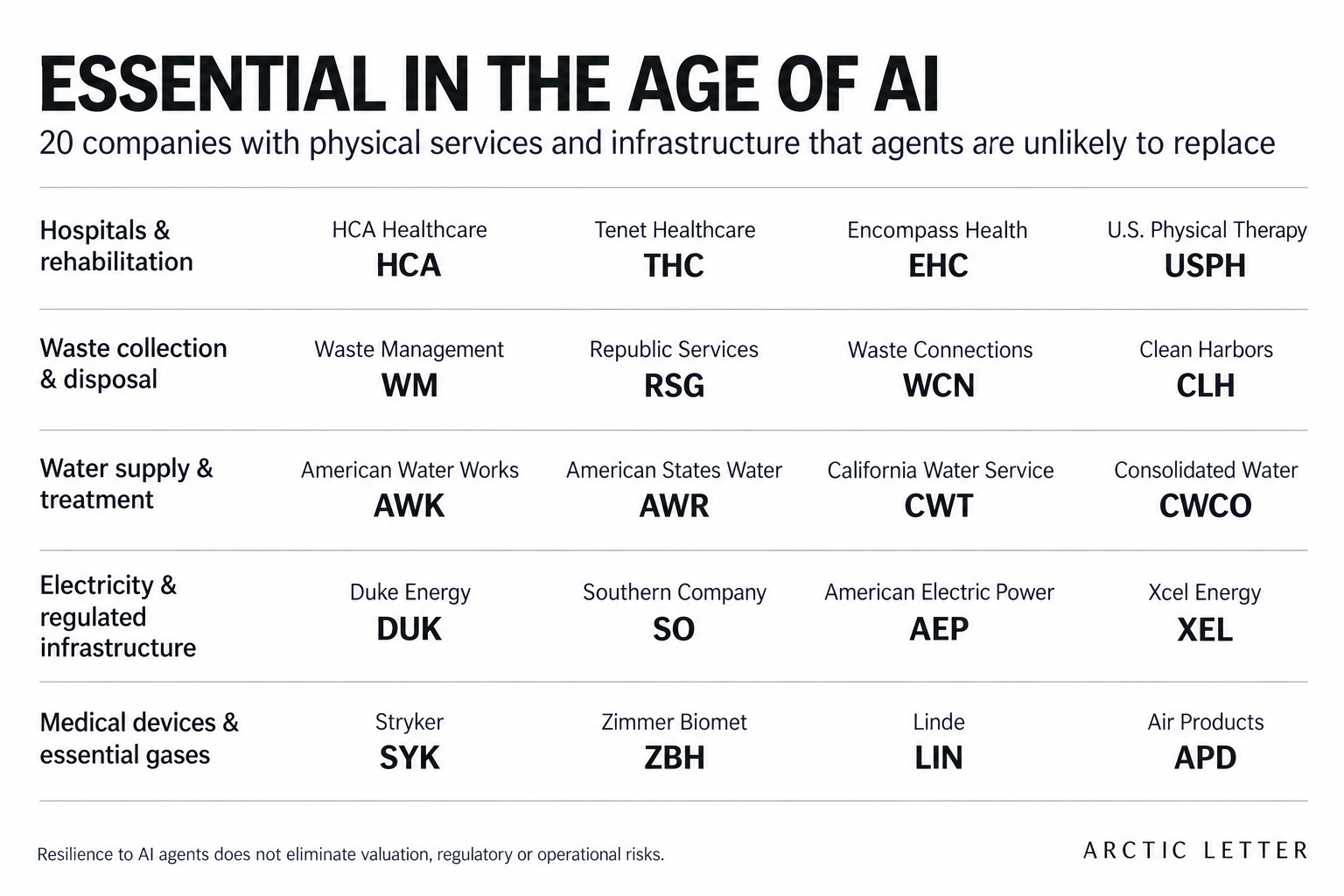
I haven’t done individual due diligence on these names yet, but I think they’re worth investigating as potential beneficiaries of a rotation driven by uncertainty around AI agents.
Meanwhile, oil is up again today following reports of a ship being struck in the Strait of Hormuz. The same movie, over and over. I don’t pretend to know how this ends. I’m still leaning bullish, and I think, and certainly hope, this Middle East “adventure” comes to an end soon. But I wouldn’t go all in. The risks are still there.
Hope you enjoyed this midweek update. A short one, but I wanted to share what’s been on my mind.
Let me know in the comments if you enjoy these “thinking out loud” pieces. I’d love to hear your feedback.
Arctic